If you wake up with a sore jaw, catch yourself clenching at your desk, or feel like the lower third of your face has gotten wider over the years, you are not imagining it — and you are not alone. Masseter Botox has quietly become one of the most requested treatments in aesthetics, and it is one of the most common conversations we have with clients here in the Quad Cities. Searches for it run in the tens of thousands every month nationally, and interest in what it costs has more than doubled in the past year.
So let’s talk about it honestly: what masseter Botox actually does, who tends to be a good candidate, what it feels like, roughly what it costs, and what it will not do. No hype, no promises — just the information you would want before booking a consultation at The Bar Aesthetics & Wellness in Bettendorf.
What Is Masseter Botox?
The masseter is the thick, powerful muscle on each side of your jaw — the one you can feel bulge when you bite down. It does the heavy lifting when you chew, and like any muscle, it can grow larger when it is overworked. Years of clenching, grinding, gum chewing, or simply strong genetics can leave the masseters noticeably developed, which reads on the face as a wider, squarer, more angular lower jaw.
Masseter Botox is the practice of injecting a neuromodulator — Botox, Dysport, or Xeomin — directly into that muscle. The product temporarily reduces how forcefully the muscle contracts. Over the following weeks, a muscle that is working less hard tends to soften in size, the same way any muscle does when it stops being trained.
Two things typically bring people in for it:
- Facial contouring. A softer masseter can make the lower face look narrower and the jawline look more tapered — often described as a more “V-shaped” or heart-shaped look.
- Clenching and grinding. Many people seek it out because their jaw is constantly tight, sore in the morning, or fatigued by the end of the day.
An important note on that second point: using a neuromodulator in the masseter for clenching or TMJ-related tension is considered an off-label use. It is a widely discussed approach in aesthetics and dentistry, but it is not an FDA-approved indication, it is not a diagnosis, and it is not a replacement for evaluation by your dentist or physician. If jaw pain is your main concern, please raise it with both your dental provider and your injector. We will always tell you when something falls outside what we can appropriately address.
Who Tends to Be a Good Candidate?
In our experience, the people who benefit most from a masseter conversation share a few traits:
- Visible squaring or widening at the angle of the jaw, especially when clenching
- A history of grinding, clenching, or a night guard prescribed by a dentist
- Facial fullness concentrated in the lower third rather than the cheeks
- Realistic expectations — this is a gradual, subtle refinement, not surgery
It is not right for everyone. If your jaw width comes primarily from bone structure rather than muscle, relaxing the muscle will not meaningfully change your contour. If you have significant skin laxity along the jawline, a different approach — such as FaceTite skin tightening or collagen-stimulating treatments — may be a better fit. And if your goal is definition rather than narrowing, strategic filler along the jaw may be the more direct route. We cover that distinction in our guide to non-surgical jawline contouring in the Quad Cities.
This is exactly why we start with a consultation rather than a price list. Two people can walk in with the same complaint and leave with two different plans.
What the Appointment Actually Looks Like
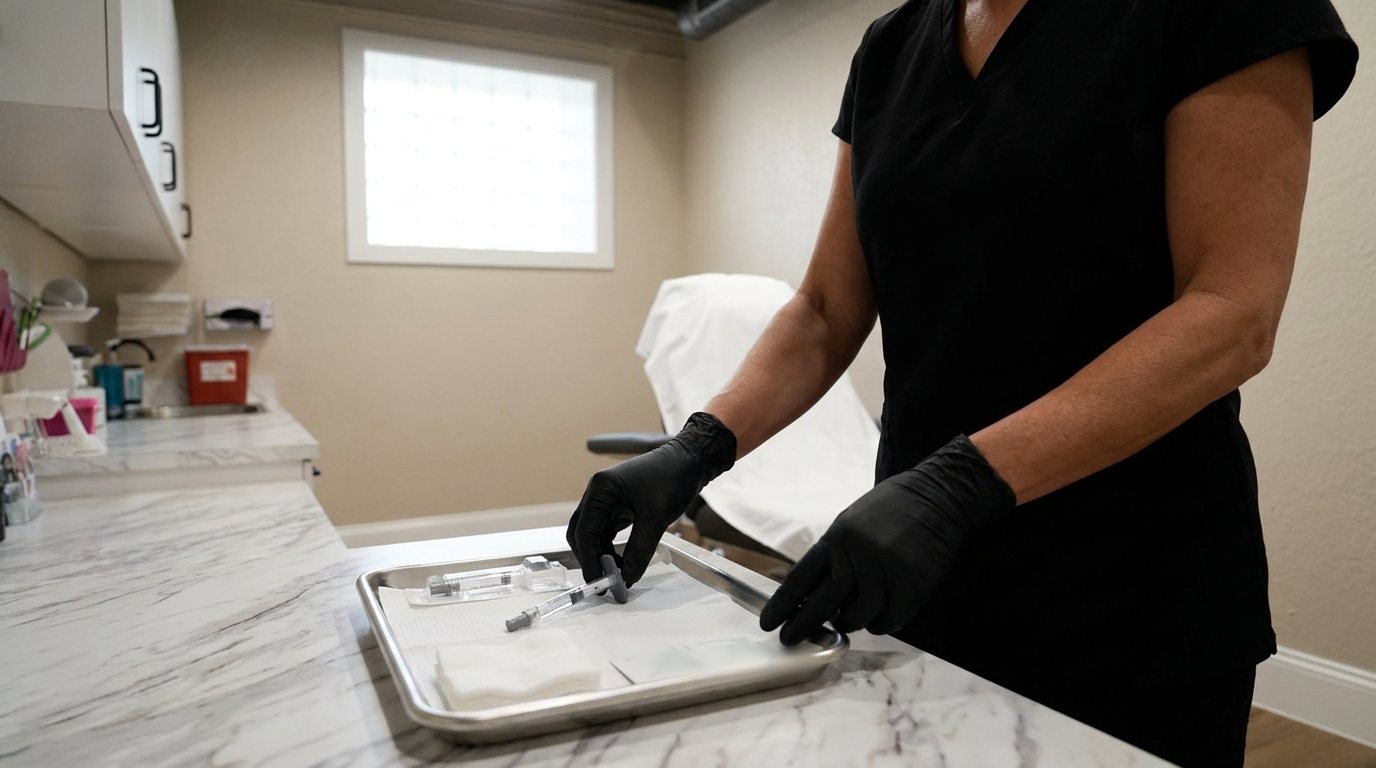
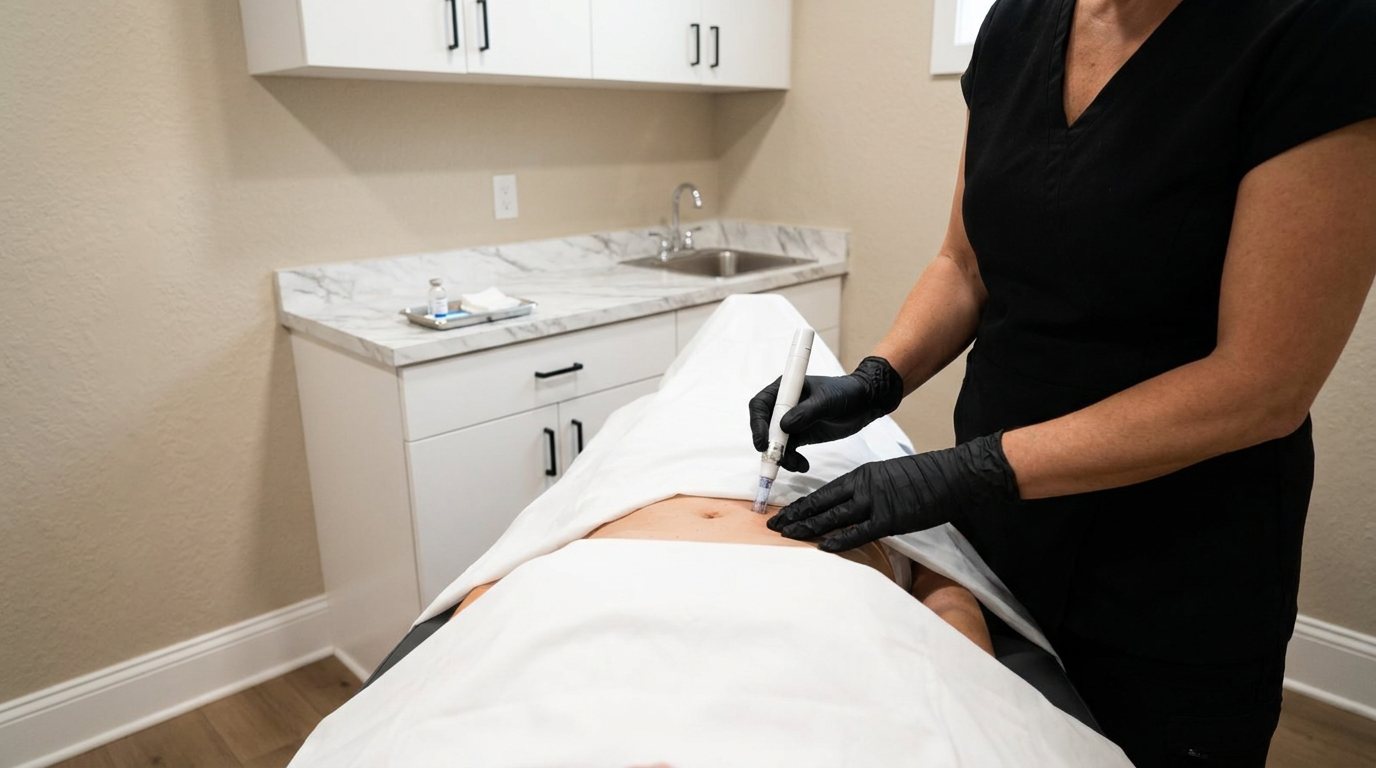
The treatment itself is short — most masseter appointments take about fifteen minutes once you are settled in the chair.
Your provider will ask you to clench so she can feel the borders of the muscle and map safe injection points. That mapping matters more than almost anything else in this treatment; the masseter sits near muscles involved in smiling, and precise placement is what keeps the result natural. Injections are placed low and deep within the muscle body, usually two to three points per side.
Most people describe the sensation as a brief pinch and pressure. There is no downtime in the sense of needing to hide at home — you can drive yourself, go back to work, and carry on with your day. We do ask you to stay upright for about four hours, skip strenuous exercise until the next day, and avoid rubbing the area.
How Long Until You See Something?
Muscle-relaxing effects on clenching often show up within one to two weeks. The visible slimming is slower, because it depends on the muscle gradually reducing in size from decreased use — many people notice a difference somewhere between six and twelve weeks, and the fullest effect often follows a second session. The masseter is a large, strong muscle, so it is common for the first treatment to be a starting point rather than the finish line.
Duration varies by person, dose, and how strong the muscle was to begin with. If you want a fuller picture of neuromodulator timelines in general, we walk through it in how long Botox lasts.
What Does Masseter Botox Cost in the Quad Cities?
Masseter treatment is priced by units, not as a flat “area,” and the masseter requires meaningfully more product than a forehead or crow’s feet treatment because the muscle is so much larger. That is the single biggest reason people are surprised by the quote.
Rather than publish a number that may not apply to you, we quote after we have actually assessed the muscle — how developed it is, whether both sides are symmetrical, and what your goal is. What we can tell you is how to read a quote intelligently:
- Ask for the unit count and the price per unit, not just a total. It is the only way to compare providers fairly.
- Ask which product is being used. Botox, Dysport, and Xeomin are dosed differently, so unit counts are not interchangeable between them. We break down the differences in our Botox vs. Dysport comparison.
- Be cautious with unusually low pricing. In an area this delicate, injector experience is not the place to bargain-hunt.
- Ask about loyalty and financing. We accept CareCredit and offer loyalty rewards, which many clients use to plan maintenance sessions.
You can see our full neuromodulator offering on our Botox & Jeuveau service page, and our broader look at local pricing in Botox in Davenport, Iowa.
Honest Expectations and Possible Side Effects
Every treatment involving a needle carries some risk, and you deserve to hear that plainly. The most common effects are mild and temporary: small bruises, tenderness at the injection sites, or a brief feeling of jaw fatigue while chewing something tough. Less commonly, an asymmetric or uneven result can occur, which is usually addressable at a follow-up.
Because the masseter contributes to chewing, some people notice their bite feels a little weaker for a few weeks, particularly with dense foods. This typically settles as your body adapts. Placement outside the intended target can affect nearby muscles involved in smiling — a real reason to choose an injector who treats this area regularly.
We do not guarantee outcomes, and we do not use before-and-after photography in our marketing. What we do commit to is a candid consultation, conservative dosing to start, and a follow-up so we can adjust rather than overcorrect.
Frequently Asked Questions
Does masseter Botox change your face shape permanently?
No. The effect is temporary and fades as muscle function returns. If you stop treating, the muscle gradually rebuilds with normal use and the lower face typically returns toward its previous appearance over several months. Some people maintain it long-term; others treat once, see how they feel, and stop.
Will masseter Botox stop my teeth grinding?
It may reduce how forcefully you clench, and many people report their jaw feels less tight. But grinding often has multiple contributors — stress, sleep, bite alignment — and this treatment does not address those. It is best thought of as one possible piece of a plan built with your dentist, not a cure. Please keep wearing a night guard if one was prescribed.
How soon can I get masseter Botox before an event?
If you are treating for clenching, allow at least two weeks. If your goal is visible slimming for a wedding, reunion, or photo session, plan much further ahead — ideally three months, so there is time for the effect to develop and for a second session if needed. Our wedding prep timeline lays out how to sequence treatments.
Ready to Talk It Through?
The honest answer to “is masseter Botox right for me?” is that it depends on your anatomy, your goals, and what is actually driving the concern — and none of that can be settled from a search results page. A consultation takes about half an hour and comes with no obligation.
The Bar Aesthetics & Wellness serves Bettendorf, Davenport, Moline, Rock Island, and the wider Quad Cities. If your jaw has been telling you something for a while, we would love to take a look. Book your consultation with The Bar and let’s build a plan that fits your face — not a template.